
Precision-Aligned Reading Intervention
Many struggling readers work hard.
They attend tutoring.
They complete homework.
They practice reading.
Yet their reading level barely moves.
This happens because the underlying issue is rarely effort.
It is skill misalignment.
When instruction does not target the exact skill deficit holding a student back, progress stalls — no matter how much practice occurs.
Our model addresses that problem directly.
Demonstrated Outcomes
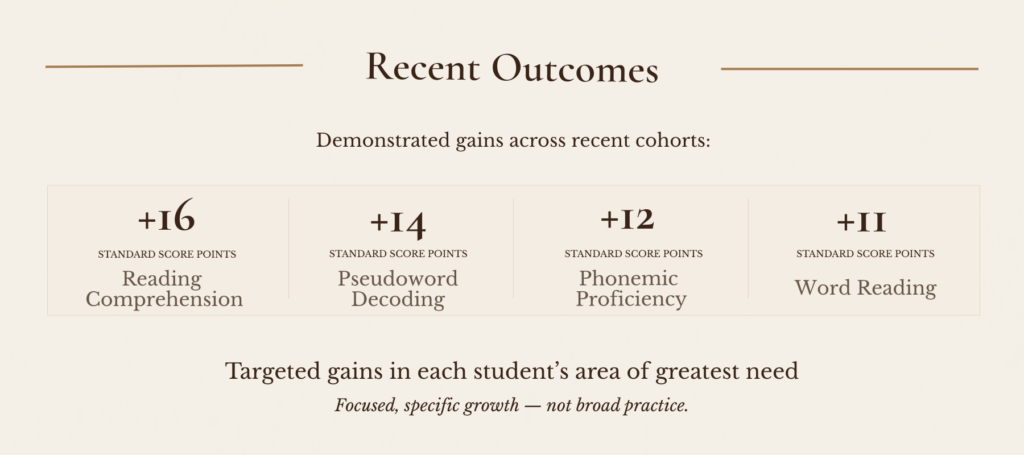
Across recent cohorts, students participating in this intervention have demonstrated measurable growth in the specific reading skills targeted for instruction.
How the Model Works
The intervention process is structured around three components.
- Precise Assessment
Before instruction begins, each student’s reading performance is evaluated to identify the specific skill deficit limiting their progress.
This may involve decoding, phonemic processing, fluency, or comprehension.
The goal is not simply to measure reading ability.
The goal is to identify the exact instructional target that will unlock growth.
2. Targeted Instruction
Instruction is then aligned directly to that skill target.
Rather than broadly covering reading material, lessons focus on the specific cognitive and linguistic processes required for improvement in that area.
This alignment ensures that every minute of instruction addresses the most important barrier to reading development.
3. Deliberate Practice
Students then engage in carefully designed practice that reinforces the targeted skill until performance becomes smooth, accurate, and automatic.
This type of practice is deliberate and structured.
It is not simply repetition.
When instruction and practice are aligned correctly, students often experience rapid acceleration in their reading development.
Why Cohort Instruction?
Students participate in small cohorts of four to six learners.
This structure allows for:
• Real-time instructional adjustments
• Continuous monitoring of each student’s responses
• Immediate corrective feedback
• Sustained instructional momentum
One-to-one tutoring can offer individual attention, but it often lacks the built-in social motivation and momentum that help students sustain effort.
Large groups reduce precision and dilute instructional alignment.
Small cohorts create the conditions for targeted instruction, active engagement, and meaningful acceleration.
What Changes for Students
The academic growth is often significant.
But the most meaningful changes are frequently behavioral and emotional.
Students who once avoided reading begin participating confidently in class.
Homework becomes manageable.
Independent learning becomes possible.
As one teacher described after observing a student’s progress:
“She went from avoiding reading entirely to volunteering to read science text aloud in class. I have never seen that kind of shift happen so quickly.”
Danielle M., 7th grade Science teacher
When reading is no longer a barrier, the effects extend across the entire academic experience.
Learn More About the Current Cohort
If you are exploring intervention options for a child who is significantly below grade level in reading, you can learn more about the current cohort here:
Placement decisions are based on intake data to ensure proper alignment between students and instructional targets.